
By Michael Phillips | Republic Dispatch
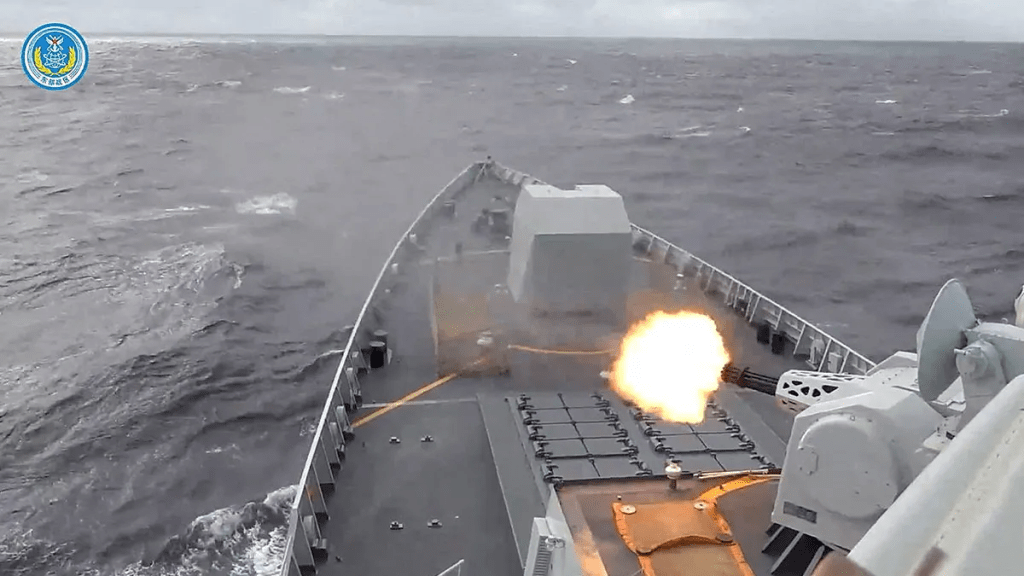
China sharply escalated military pressure on Taiwan this week, launching large-scale joint exercises that simulate blockades, live-fire strikes, and anti-intervention operations—moves widely interpreted as a direct warning to the United States, Japan, and any outside power prepared to defend the island.
The drills, codenamed “Justice Mission 2025,” were announced Monday by China’s People’s Liberation Army, marking the most expansive military activity around Taiwan since April and the sixth major encirclement exercise since 2022. Units from the army, navy, air force, rocket force, and coast guard participated under the PLA’s Eastern Theater Command, with live-fire phases scheduled for Tuesday.
According to Taiwan’s defense ministry, Chinese forces deployed 89 military aircraft and 28 naval and coast guard vessels, with most aircraft crossing the long-standing median line of the Taiwan Strait. Taiwan responded by placing missile units on high alert and scrambling fighter jets to monitor Chinese movements.
A Blockade Rehearsal in All but Name
Unlike earlier drills, Justice Mission 2025 explicitly rehearses blockade-style operations, including simulated seizures of ports, energy facilities, and maritime choke points. Chinese military statements described the exercise as practicing “all-dimensional deterrence outside the island chain”—language analysts say is aimed squarely at denying U.S. and Japanese forces access in a Taiwan contingency.
Exercise zones released by Beijing show multiple restricted areas encircling Taiwan, some overlapping its 12-nautical-mile territorial waters. The impact was immediate: more than 850 commercial flights were diverted or canceled, affecting over 100,000 passengers across East Asia.
Taiwan’s government condemned the drills as an “irrational provocation” and accused Beijing of deliberately undermining regional stability. Still, officials emphasized that markets remained calm and daily life continued uninterrupted—underscoring Taiwan’s effort to project resilience rather than panic.
Triggered by U.S. Arms and Regional Resolve
Beijing’s timing is no coincidence. The drills come just 11 days after the Trump administration approved a record $11.1 billion arms sale to Taiwan, the largest single package in U.S. history. The sale includes HIMARS rocket systems, self-propelled artillery, drones, and anti-armor weapons designed for asymmetric defense.
From a center-right perspective, the message is clear: China’s reaction validates the necessity of deterrence, not its danger. Beijing’s willingness to escalate military pressure following defensive arms transfers reinforces longstanding concerns that appeasement only emboldens aggression.
Taiwanese President Lai Ching-te has framed his defense strategy around “raising the difficulty” of any invasion while maintaining the status quo. Recent polling shows most Taiwanese voters reject both formal independence and unification, favoring peace backed by strength.
Japan Drawn More Directly Into the Equation
Another underreported factor is Japan’s increasingly explicit stance on Taiwan’s security. Prime Minister Sanae Takaichi recently stated that a Chinese attack on Taiwan could constitute a “survival-threatening situation” for Japan—potentially triggering collective self-defense under Japanese law.
Beijing has reacted angrily, warning Tokyo against interference and escalating diplomatic pressure. Justice Mission 2025 appears designed in part to signal that any Japanese involvement would face immediate military resistance.
Japan’s geography—particularly its southwestern islands near Taiwan—makes neutrality difficult in any conflict. From Washington’s perspective, stronger Japanese clarity enhances deterrence by raising the cost of Chinese miscalculation.
Gray-Zone Pressure, Not Yet War
Despite the scale of the drills, there is no evidence of imminent invasion. Instead, the exercises fit China’s broader “gray-zone” strategy: normalize coercive military pressure, test regional responses, and intimidate Taiwan without crossing the threshold into open conflict.
Still, the risks are real. Large-scale maneuvers increase the chances of accidents or misjudgments, especially if U.S. or allied naval patrols operate nearby. Each new drill pushes boundaries further, gradually redefining what Beijing considers “normal” around Taiwan.
For Washington and its allies, Justice Mission 2025 underscores a central reality of Indo-Pacific security: peace is preserved not by concession, but by credible deterrence. China’s drills may end quietly this week—but the strategic contest over Taiwan is entering a sharper, more dangerous phase.
 The Republic Dispatch