
By Michael Phillips | Republic Dispatch
The Pentagon’s latest China Military Power Report is blunt in a way Washington documents rarely are: China’s military buildup is now large enough, modern enough, and ambitious enough to directly threaten the U.S. homeland. That alone should focus minds in Congress and the White House.
But what matters most is how we read this report — and what we choose to do with it.
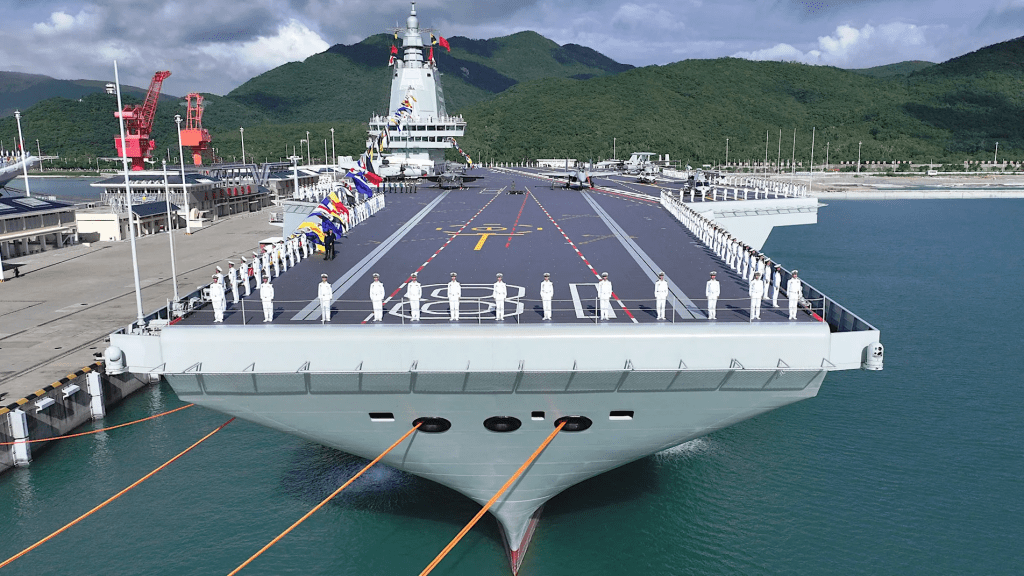
The Department of Defense describes a “historic” expansion by the People’s Liberation Army, from nuclear forces projected to exceed 1,000 warheads by 2030 to a navy aiming for nine aircraft carriers by 2035. These numbers are not speculative. They reflect deliberate choices by Beijing to challenge American power, deter U.S. intervention, and coerce neighbors — especially Taiwan.
At the same time, buried beneath the headlines is a more complicated reality: China is building fast, but not cleanly. And that matters for U.S. strategy.
Quantity Has a Quality of Its Own — Until It Doesn’t
The report confirms what defense analysts have warned for years. China is racing to close gaps across every domain — nuclear, naval, missile, cyber, space — not to achieve parity, but to overwhelm. Even with slower nuclear growth than previously projected, Beijing is fundamentally reshaping the strategic balance by normalizing launch-on-warning postures and diversifying delivery systems.
This is not defensive modernization. It is a conscious bid to make American decision-making riskier, slower, and more uncertain.
Yet the same report also documents something rarely emphasized in mainstream coverage: deep internal instability within the PLA itself.
Corruption purges have swept through the Rocket Force, naval leadership, and procurement arms. Senior officers once considered untouchable have been detained or disappeared. The pierside sinking of an advanced Chinese nuclear submarine during construction — quietly acknowledged in the report — is not just an embarrassment. It’s a symptom of a system straining under speed, secrecy, and fear.
This is the paradox of modern authoritarian militaries. Centralized control accelerates expansion — until it starts breaking things.
Taiwan: Fewer Words, Sharper Edges
One of the most telling signals in the report isn’t hardware at all — it’s language. Beijing has quietly deemphasized references to “peaceful unification,” replacing them with operational readiness and coercive capability. Exercises now test blockades, long-range strikes, and attacks designed to keep U.S. forces at bay.
The 2027 readiness directive remains intact. But the message is broader: China wants the option to act before the U.S. or its allies can respond decisively.
That doesn’t mean war is inevitable. It does mean deterrence must be credible — not rhetorical.
Diplomacy Without Illusions
The contrast between the Pentagon’s warning and recent diplomatic warmth is striking. President Trump’s acceptance of Xi’s invitation for a 2026 visit signals a desire to stabilize relations and avoid miscalculation. That’s sensible. Serious powers talk.
But diplomacy only works when backed by strength and clarity. Beijing is not modernizing its military because it fears peace talks will fail. It is modernizing because it wants leverage — over Taiwan, over regional allies, and ultimately over the global order.
Pretending otherwise is how deterrence erodes.
The Right Lesson for America
A center-right reading of this report should reject two extremes: panic and complacency.
China is not ten feet tall. Corruption, quality-control failures, and internal distrust weaken the PLA in ways raw numbers can’t hide. But neither is this a paper tiger. A hollow force can still be devastating if miscalculation occurs.
The correct response is disciplined strength:
- Sustain and modernize U.S. nuclear deterrence.
- Accelerate shipbuilding and undersea dominance.
- Harden Pacific basing and logistics.
- Demand real burden-sharing from allies.
- Exploit adversary weaknesses without underestimating their intent.
Peace through strength isn’t a slogan — it’s a strategy that assumes adversaries act rationally only when costs are unmistakable.
The Pentagon’s report is not a call for war. It’s a warning against drift. China is moving with purpose. America must do the same — eyes open, illusions discarded, and deterrence restored.
 Republic Dispatch