By Michael Phillips | Republic Dispatch
By any reasonable moral or strategic standard, what is happening to Christians in Nigeria should be front-page news in the United States. Instead, it remains one of the most lethal—and least discussed—religious freedom crises in the world.
Human rights and church-based monitoring groups estimate that more than 7,000 Christians were killed in 2025 alone, averaging roughly 30–35 deaths per day. Since 2009, the death toll is estimated at well over 100,000, alongside tens of thousands abducted, nearly 20,000 churches destroyed, and millions displaced. Nigeria has become, by virtually every serious measure, the deadliest country on earth for Christians.
Yet this catastrophe rarely breaks into major U.S. headlines.
A Crisis Hidden in Plain Sight
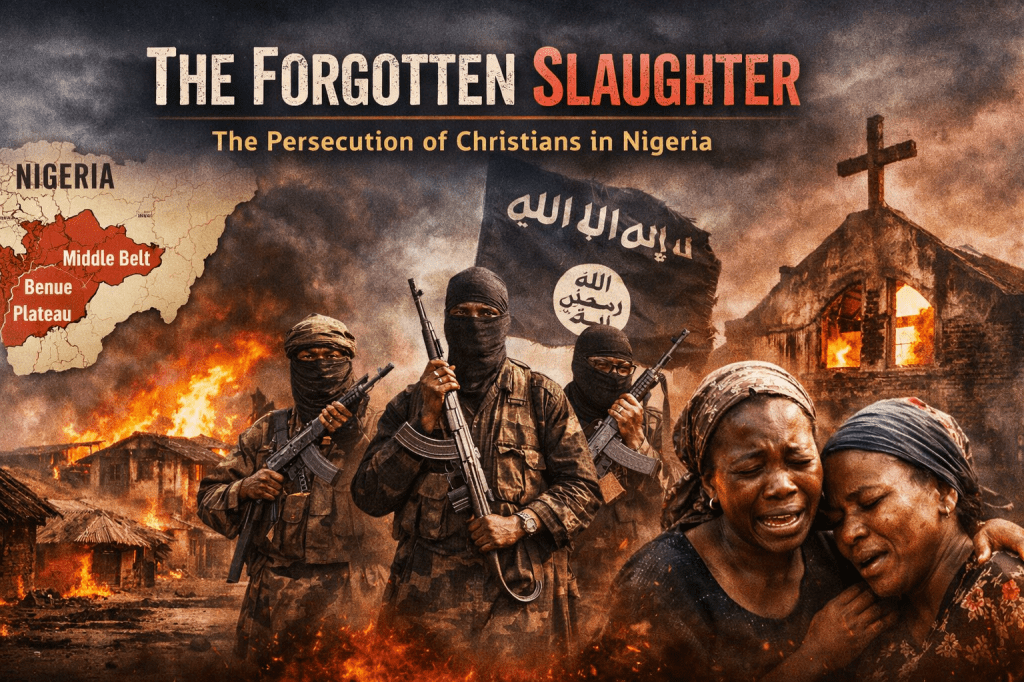
Nigeria is Africa’s most populous nation, roughly divided between a predominantly Muslim north and a largely Christian south, with the volatile “Middle Belt” caught between them. The violence is not theoretical. It is physical, brutal, and ongoing.
In the northeast, jihadist groups like Boko Haram and its ISIS-linked offshoot ISWAP openly target Christians—burning churches, kidnapping clergy, and executing believers as part of their stated goal to impose an Islamist caliphate.
In the Middle Belt, armed Fulani militants have carried out repeated raids on Christian farming villages in states like Benue and Plateau. Survivors consistently describe attackers shouting religious slogans, torching churches, and massacring families. A June 2025 attack in Yelewata reportedly killed hundreds in a single night.
Nigerian authorities often describe these incidents as “farmer-herder clashes” or generalized criminality. There is truth in the complexity—land disputes, climate pressures, and banditry all play roles—but complexity does not negate reality. When villages are systematically targeted, churches destroyed, and religious identity used to select victims, religious persecution is not incidental. It is central.
Why the Silence?
So why does this not command sustained attention in the West?
First, the story is inconvenient. It does not fit neatly into fashionable narratives about global oppression. The victims are overwhelmingly Christian, often rural, and often poor—hardly a demographic with a powerful media megaphone.
Second, journalists and institutions are wary of discussing Islamist violence without layers of qualification, fearing accusations of bias or “Islamophobia.” The result is a kind of rhetorical paralysis that treats clarity as danger and silence as safety.
Third, the numbers are disputed. Advocacy organizations such as Open Doors and Nigeria-based Intersociety focus specifically on faith-targeted killings, while neutral conflict trackers like ACLED count all civilian deaths regardless of motive. But debate over methodology should not obscure the core fact: Nigeria accounts for roughly two-thirds of all Christians killed worldwide in recent years.
Even if one adopts the most conservative estimates, the scale of suffering is staggering.
A Test of Religious Freedom Credibility
To its credit, the U.S. government has begun to re-engage. In late 2025, Nigeria was redesignated a “Country of Particular Concern” for religious freedom violations—a status urged by groups like the U.S. Commission on International Religious Freedom. That designation opens the door to sanctions, aid conditions, and diplomatic pressure.
But labels alone do not save lives.
For observers, this crisis poses a fundamental question: Does religious freedom still matter as a universal principle, or only when it aligns with preferred political narratives? If tens of thousands can be slaughtered for their faith with minimal international response, the answer is troubling.
Nigeria is not a distant, irrelevant conflict. It is a strategic U.S. partner, a linchpin in West African security, and a frontline state against global jihadist movements. Allowing religious cleansing—whatever euphemisms are used—to continue unchecked is both a moral failure and a geopolitical risk.
Why We Should Care—Now
This is not about privileging one faith over another. Muslims, too, have been victims of jihadist violence in Nigeria. But acknowledging that reality does not require ignoring the disproportionate targeting of Christians in key regions.
Silence does not equal neutrality. It equals abandonment.
If religious liberty is to mean anything beyond rhetoric, Nigeria must stop being treated as an afterthought. Awareness leads to pressure. Pressure leads to protection. And protection, in this case, could mean the difference between life and death for thousands whose names we will never know—unless we choose to look.
The killings are happening every day.
The only question is whether we are willing to notice.
 Republic Dispatch