
By Michael Phillips | Republic Dispatch
The U.S. military has confirmed the deaths of eight people following airstrikes on three vessels in international waters of the eastern Pacific Ocean, marking the latest escalation in the Trump administration’s expanding campaign against drug trafficking networks now labeled as terrorist organizations.
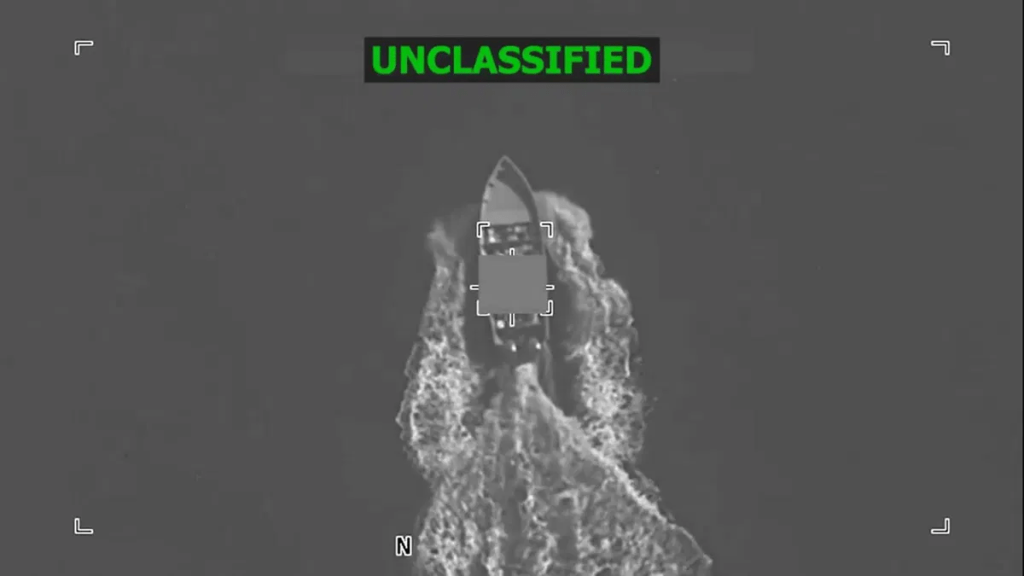
According to U.S. Southern Command (SOUTHCOM), the strikes were carried out on December 15 and targeted boats believed to be operating along established narcotics trafficking routes from South America. U.S. officials described those killed as male “narco-terrorists,” reporting three deaths on one vessel, three on another, and two on the third. All three boats were destroyed.
Video footage released by SOUTHCOM shows precision strikes hitting small vessels, resulting in explosions and rapid sinking. The military stated the operation was intelligence-driven and conducted under Operation Southern Spear, a campaign launched earlier this fall under Defense Secretary Pete Hegseth.
A Shift From Interdiction to Lethal Force
Operation Southern Spear represents a significant shift in U.S. counter-narcotics policy. For decades, the U.S. relied primarily on Coast Guard interdictions, seizures, and arrests. Since September 2025, however, the administration has authorized direct military strikes after designating several major drug cartels as foreign terrorist organizations.
As of mid-December, reporting across multiple outlets indicates:
- 25–26 strikes on suspected trafficking vessels
- Roughly 95 deaths linked to those operations
- Activity concentrated in the eastern Pacific, with some strikes in the Caribbean
Administration officials argue the shift is necessary given the scale of the drug crisis. President Trump has repeatedly framed fentanyl trafficking as a form of asymmetric warfare against the United States, a position reinforced the same day as the latest strikes when he signed an executive order designating illicit fentanyl and its precursor chemicals as weapons of mass destruction.
Supporters say this designation provides additional legal authority to treat trafficking networks as national security threats rather than criminal enterprises.
Legal and Ethical Questions Intensify
Despite the administration’s confidence, the campaign has triggered growing controversy at home and abroad.
Legal scholars and human-rights observers argue the strikes raise serious questions under international law, particularly regarding:
- Extrajudicial killings in international waters
- Lack of publicly presented evidence showing drugs on the targeted vessels
- No disclosure of identities or organizational roles of those killed
Critics note that in many cases, including this most recent incident, no narcotics have been recovered or displayed, leaving the public reliant on classified intelligence claims that cannot be independently verified.
Earlier strikes in September drew heightened scrutiny after reports that follow-up attacks were conducted on survivors in the water, prompting allegations—denied by Pentagon officials—of potential violations of the laws of armed conflict.
Effectiveness vs. Optics
Another unresolved question is whether the strikes meaningfully disrupt the fentanyl supply fueling U.S. overdoses.
Public health experts and law enforcement officials have long stated that most fentanyl enters the United States through land ports of entry, often concealed in vehicles or carried by U.S. citizens—not via maritime routes more commonly associated with cocaine trafficking. Critics argue that while the strikes may degrade some smuggling operations, their impact on the opioid crisis remains unclear.
At the same time, traditional interdiction efforts in 2025 reportedly seized record quantities of narcotics without loss of life, raising questions about whether lethal force is producing better results or simply more dramatic imagery.
Geopolitical Tensions Rising
Regional reactions have been sharp. Venezuela has condemned the operations as violations of sovereignty and accused Washington of using counter-drug operations as a pretext for broader geopolitical pressure, particularly following recent U.S. actions involving Venezuelan oil assets.
Members of Congress from both parties have requested briefings, with some Democrats and a handful of Republicans calling for clearer legal justifications, oversight mechanisms, and metrics for success beyond strike counts and body totals.
A Defining Test of Policy
Supporters of the administration see Operation Southern Spear as long-overdue resolve against cartels they describe as mass killers poisoning American communities. They argue intelligence-based strikes save lives by deterring traffickers and dismantling networks before drugs reach U.S. streets.
Opponents counter that without transparency, evidence, or clear success measures, the campaign risks normalizing lethal force in situations traditionally handled by law enforcement—setting precedents that may be difficult to contain.
As the administration signals that operations will continue—and possibly expand—the eastern Pacific strikes underscore a defining question now facing the country: whether the war on drugs has formally become a war in the military sense, and what that means for law, accountability, and America’s role beyond its borders.
 Republic Dispatch