
By Michael Phillips | Republic Dispatch
Peace negotiations aimed at ending Russia’s nearly four-year war in Ukraine entered a second day in Berlin on Monday, marking what European leaders are calling the most intensive diplomatic push since the conflict began—and a defining moment for Europe’s security future.
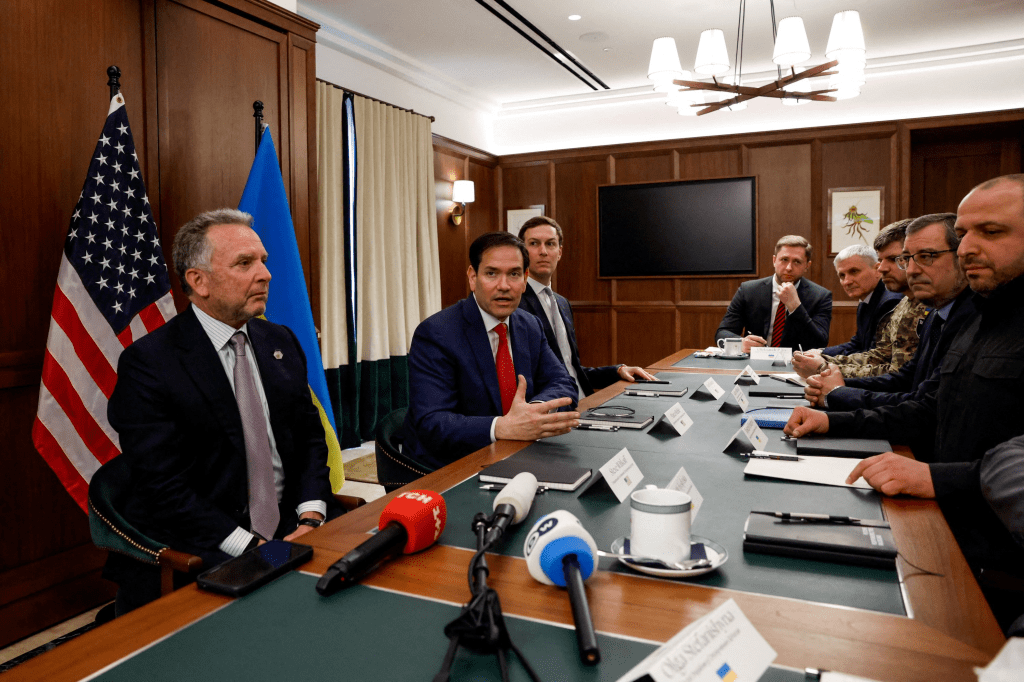
Hosted by German Chancellor Friedrich Merz, the talks brought together Ukrainian President Volodymyr Zelenskiy, senior U.S. envoys, and a growing roster of European leaders, as Washington presses for a framework to halt what has become Europe’s deadliest war since World War II.
U.S.-Led Momentum, European Stakes
President Donald Trump’s administration has framed the Berlin talks as a necessary intervention after years of stalemate. U.S. special envoy Steve Witkoff and senior adviser Jared Kushner met with Zelenskiy for more than five hours on Sunday, with negotiations resuming Monday. U.S. officials described “a lot of progress,” citing work on three draft pillars: a 20-point peace framework, security guarantees for Ukraine, and post-war reconstruction.
Finnish President Alexander Stubb, who also met with Zelenskiy, called the moment “critical,” saying negotiators are “closer to a peace agreement than at any point in these four years.”
But beneath the optimism, major divisions remain—especially over territory, security guarantees, and Russia’s absence from the table.
Zelenskiy’s NATO Concession—and Its Limits
In what may be his most consequential offer of the war, Zelenskiy signaled willingness to abandon Ukraine’s long-standing bid for NATO membership in exchange for what he called “robust and binding” Western security guarantees. The move reflects growing war fatigue at home and mounting pressure from allies to show flexibility.
Kyiv, however, continues to reject unilateral territorial concessions, particularly in the Donbas region, where Ukraine still controls roughly 10 percent of territory claimed by Moscow. Ukrainian officials insist any settlement must preserve sovereignty and avoid legitimizing conquest by force.
That line puts Ukraine at odds with Moscow’s stated demands.
Russia’s Hardline Position—and Absence
Russia is not directly participating in the Berlin talks. Instead, the Kremlin says it is awaiting updates from U.S. intermediaries—a posture critics argue signals bad faith rather than engagement.
Kremlin spokesman Dmitry Peskov reiterated that Ukrainian neutrality and permanent exclusion from NATO remain “cornerstones” of any deal. Moscow also demands Kyiv withdraw from remaining parts of Donbas, bar foreign troops from Ukrainian soil, and accept limits on its future military posture.
Meanwhile, Russian forces continue strikes on Ukrainian infrastructure, including energy facilities—undercutting the credibility of ceasefire discussions and reinforcing skepticism among European officials that President Vladimir Putin is negotiating to compromise rather than consolidate gains.
The Security Guarantee Question
One of the least resolved—and most consequential—issues is what replaces NATO. While headlines highlight Zelenskiy’s NATO concession, far less clarity exists on what the proposed security guarantees actually mean.
Key questions remain unanswered: Who enforces them—the U.S., Europe, or both? Are they legally binding, like NATO’s Article 5, or political assurances similar to the failed Budapest Memorandum? And what happens if Russia violates them?
European leaders, wary of past failures such as the Minsk agreements, are pressing for enforceable mechanisms, potentially including European-led peacekeeping forces. Early U.S. drafts, however, are viewed in some capitals as too vague and too focused on speed over durability.
Europe Pushes Back—Quietly
While publicly projecting unity, European leaders are also resisting what they see as a rushed, U.S.-driven deal that risks rewarding aggression. France, Britain, Germany, and others are insisting there be no “over-the-heads” settlement imposed on Ukraine.
This week underscores Europe’s stakes. EU foreign ministers met Monday to finalize new sanctions on Russia, while a summit on Thursday will decide whether to leverage frozen Russian central bank assets—estimated at €300 billion—to fund Ukraine’s reconstruction and defense.
These moves reflect a broader European strategy: balance U.S. pressure for a deal with safeguards that prevent the war from simply freezing into a more dangerous future conflict.
A Center-Right Reality Check
From a center-right perspective, the Berlin talks reflect overdue realism. The war has drained Western resources, strained unity, and pushed escalation risks higher. Trump’s insistence on negotiations has forced long-avoided trade-offs into the open—and that is not weakness, but diplomacy.
At the same time, skepticism of Moscow is warranted. Any agreement that lacks enforcement risks becoming another temporary pause before renewed aggression. Ending “blank-check” aid does not mean endorsing appeasement; it means demanding accountability, burden-sharing from Europe, and a settlement that deters future wars rather than invites them.
A negotiated end—possibly freezing current lines—may be imperfect. But endless war is worse.
No Breakthrough—Yet
As talks resumed Monday, no agreement had been announced. Russia signaled conditional openness to “serious proposals,” without budging on core demands. Ukraine, under pressure at home and abroad, is testing how far compromise can go without becoming capitulation.
What is clear is this: Berlin is not just about ending one war. It is about whether Europe and the United States can craft a security order that deters aggression, limits escalation, and closes one of the bloodiest chapters of the 21st century without reopening it later.
The next few days may decide whether diplomacy finally overtakes the battlefield—or merely pauses it.
 Republic Dispatch