
By Michael Phillips
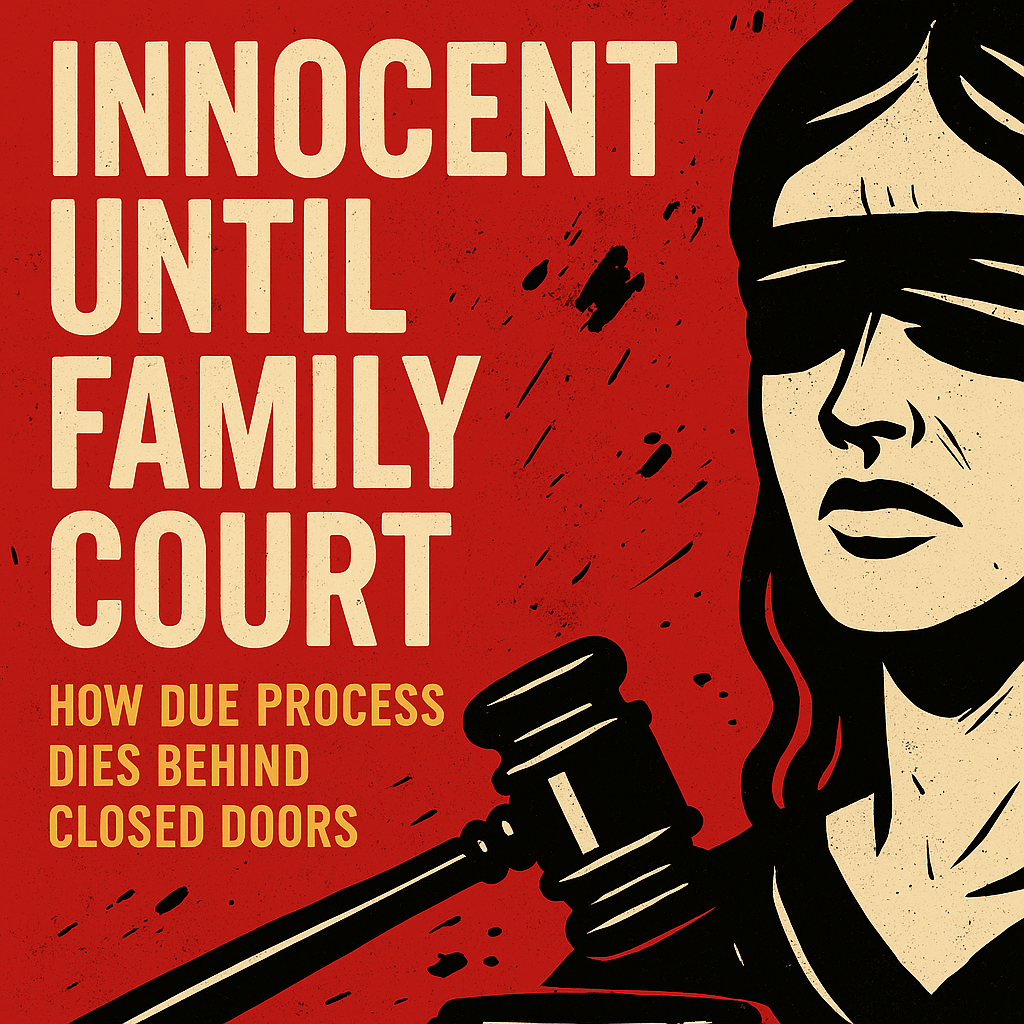
“Innocent until proven guilty.”
“Right to a fair trial.”
“No punishment without evidence.”These are the bedrock principles of American justice.
Except in family court. There, they don’t exist.
Across the United States, millions of parents have walked into family court believing their constitutional rights would follow them through the doors. They believed they’d be presumed innocent, that facts and evidence would matter, that the truth would win.
But family court is not a criminal court. It does not require evidence beyond a reasonable doubt. It has no jury. There is no right to a court-appointed attorney, even if you’re indigent. And in many cases, judges have almost unchecked discretion to make decisions that devastate lives—with no accountability if they get it wrong.
Welcome to Family Court: Where Guilt Is Assumed
In family court, the presumption is not innocence. The presumption is conflict. The presumption is dysfunction. And in many cases, the presumption is guilt—especially if you’re a father, a pro se litigant, or someone with a disability or mental health history.
False allegations are routine. Protective orders are handed out with minimal scrutiny. One-sided stories are accepted at face value, while the accused is given just minutes to defend themselves against life-altering accusations. You don’t get to cross-examine your accuser before you lose your child.
In family court, the accusation is the punishment.
No Jury. No Record. No Rights.
Unlike criminal trials, family court hearings are typically conducted in front of a single judge. There is no jury of your peers. There is often no court reporter unless you request—and pay—for one. Key evidence can be ignored. Witnesses can be excluded. Judges may not even read your full case file before making a decision that tears your child from your arms.
If you try to represent yourself, you’re mocked, patronized, or stonewalled. If you can’t afford a lawyer, you’re treated as if you chose poverty. There is no Miranda warning. No “right to remain silent.” Everything you say will be twisted against you—especially if you dare to defend yourself with emotion.
Temporary Orders Become Permanent Injustice
One of the most dangerous features of family court is the temporary order. These are “interim” rulings, often made during an emergency or based on limited evidence, meant to hold things in place until a full hearing can be held.
But that hearing never really comes.
What starts as “temporary” becomes the new status quo. Judges default to the path of least resistance. “Well, the child has been with Parent A for three months now… we shouldn’t disrupt that.”
It doesn’t matter if Parent B was unfairly removed. It doesn’t matter if it was based on lies. The court now views the unjust arrangement as the child’s “stability”—and stability always wins.
Justice delayed in family court is justice denied forever.
Your Mental Health Is a Weapon, Not a Context
If you mention a diagnosis—ADHD, PTSD, anxiety—you’re suddenly labeled unstable, unfit, unsafe. Judges rarely distinguish between a managed condition and a dangerous one. They rely on court-appointed therapists and evaluators who may never meet your child, but whose opinions carry more weight than facts or history.
What should be reasonable accommodations become disqualifiers. The need for support is weaponized into the narrative of incapacity. This is not justice. It’s ableist profiling disguised as judicial prudence.
The Burden of Proof Is on You—and It’s Impossible
In criminal court, the government has to prove your guilt. In family court, you have to prove your innocence.
But how do you prove you’re not abusive? How do you prove you didn’t do what someone claims in a sworn affidavit filed under seal? How do you undo the damage once a temporary order has taken your child away and poisoned the perception of who you are?
You can’t. And the system knows it.
Family Court Is a Due Process Dead Zone
Let’s be clear: family court isn’t broken because it fails once in a while. It’s broken because it systematically fails the very principles we hold sacred. There is no due process. There is no burden of proof. There is no transparency.
And the consequences are catastrophic:
- Innocent parents are cut off from their children.
- False accusers are rewarded.
- Real victims are disbelieved.
- Trauma is reinforced, not healed.
What Can Be Done?
We must stop pretending that family court operates like any other courtroom. It doesn’t. And it never will—until we force it to.
We need:
- Constitutional safeguards in family law proceedings.
- Mandatory audio/video records of all hearings.
- Abolition of secret dockets and sealed filings that hide misconduct.
- Access to public defenders or legal aid for custody disputes involving allegations.
- Federal oversight of state court abuses involving parental rights.
Because if the government can take your child with no evidence, no trial, and no accountability, then you don’t live in a free country.
You live in a bureaucratic gulag masquerading as a courtroom.
Up Next in the Series:
The Price of Your Child: How Family Court Became a Billion-Dollar Industry
Author Bio:
Michael Phillips is the founder of Father & Co. and the REBUILT Justice Project. A journalist, advocate, and legal reform strategist, he writes about family court corruption, trauma recovery, and rebuilding life after legal and emotional devastation. His work appears on Medium, Substack, and in reform publications across the country.
 Republic Dispatch