When Reality Became a Private Product
First, they privatized courts. Then, they privatized armies. Finally, they set their sights on something far more powerful: reality itself.
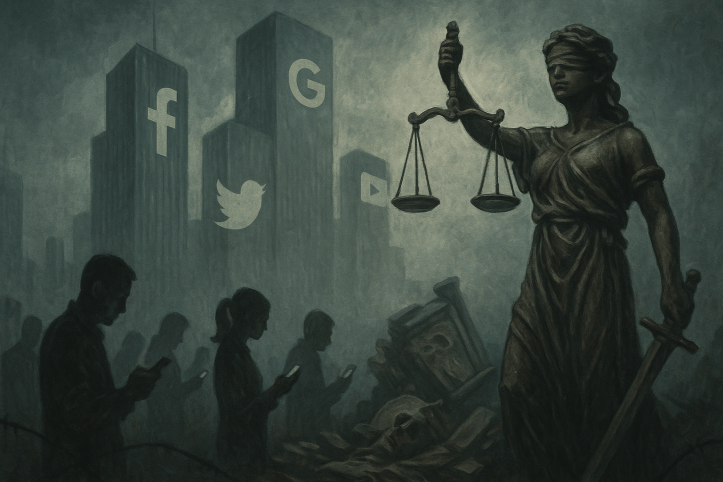
Over the past two decades, the world’s most powerful corporations — Google, Facebook, Twitter, Amazon — have quietly transformed from platforms into governments. But these governments aren’t bound by constitutions, public votes, or democratic transparency.
They rule through algorithms. Through “terms of service.” Through invisible digital hands that shape what we see, hear, and believe.
Reality is no longer a public good. It has been privatized.
Part 1: The Myth of Neutral Platforms
In the early 2000s, tech companies branded themselves as “neutral platforms” — a digital town square where anyone could speak freely.
It was a lie.
From the beginning, algorithms curated content. Recommendation engines prioritized certain voices over others. Advertising incentives rewarded outrage, polarization, and sensationalism.
By 2016, it was undeniable: platforms like Facebook and Twitter weren’t neutral. They were editors — deciding what information spread, what was buried, and what was erased.
And they did it without public input, oversight, or accountability.
Part 2: Government Outsourcing Censorship
After the 2016 election, the U.S. government began partnering with Big Tech more openly.
- The Department of Homeland Security (DHS) coordinated with platforms to flag “misinformation.”
- The FBI met regularly with social media executives to discuss “content moderation priorities.”
- The CDC advised Facebook and Twitter on what health-related posts should be suppressed during COVID-19.
Rather than openly censoring speech — a violation of the First Amendment — government agencies simply nudged private corporations to do it for them.
It was outsourcing censorship.
The public lost constitutional protections against government overreach — because the government wasn’t doing the silencing directly. Their corporate partners were.
Part 3: Algorithmic Reality Control
Algorithms became the new judges and juries of truth.
- What stories trend?
- Which voices are amplified?
- What content is “recommended” to you?
All decided by proprietary formulas optimized not for truth, but for engagement — outrage, fear, tribalism.
Platforms learned that keeping users addicted to outrage generated the most profit. Truth became irrelevant. Reality was whatever the algorithm said it was.
And these algorithms were, and remain, completely invisible to the public.
You don’t choose your reality anymore. It chooses you.
Part 4: Information as a Weapon
Big Tech companies didn’t just influence public opinion domestically. They became tools of geopolitical power.
- Facebook partnered with governments to influence elections abroad.
- Twitter “blacklists” and “whitelists” shaped political discourse globally.
- Google altered search results to favor preferred narratives.
Information became a weapon of war — deployed not just by states, but by corporations themselves, often in alignment with state interests.
Democracy requires informed consent. But when information itself is manipulated, consent becomes manufactured.
Part 5: The End of Public Consent
Today, we live in a world where unelected tech executives have more influence over public discourse, elections, and national policies than any elected official.
- Content moderation teams decide which candidates get visibility.
- Shadow bans and algorithmic throttling decide which movements gain traction.
- Corporate partnerships with intelligence agencies blur the lines between private enterprise and state surveillance.
The public square has been privatized.
Citizens no longer debate openly in a shared space. They are funneled, curated, manipulated, and monitored inside private fiefdoms.
The government didn’t just lose control of reality. It sold it.
Reclaiming Reality
First they privatized war. Then they privatized justice. Now they’ve privatized reality itself.
If citizens do not reclaim the public square — if we do not demand transparency, open debate, and constitutional protections in our digital spaces — there will soon be no public left to govern.
We stand at a crossroads.
Will we remain digital serfs, ruled by invisible algorithms and corporate overlords?
Or will we rise, reclaim our voices, and rebuild the broken foundations of a truly public, truly free society?
The choice is ours.
If we are brave enough to see it.
 Republic Dispatch