
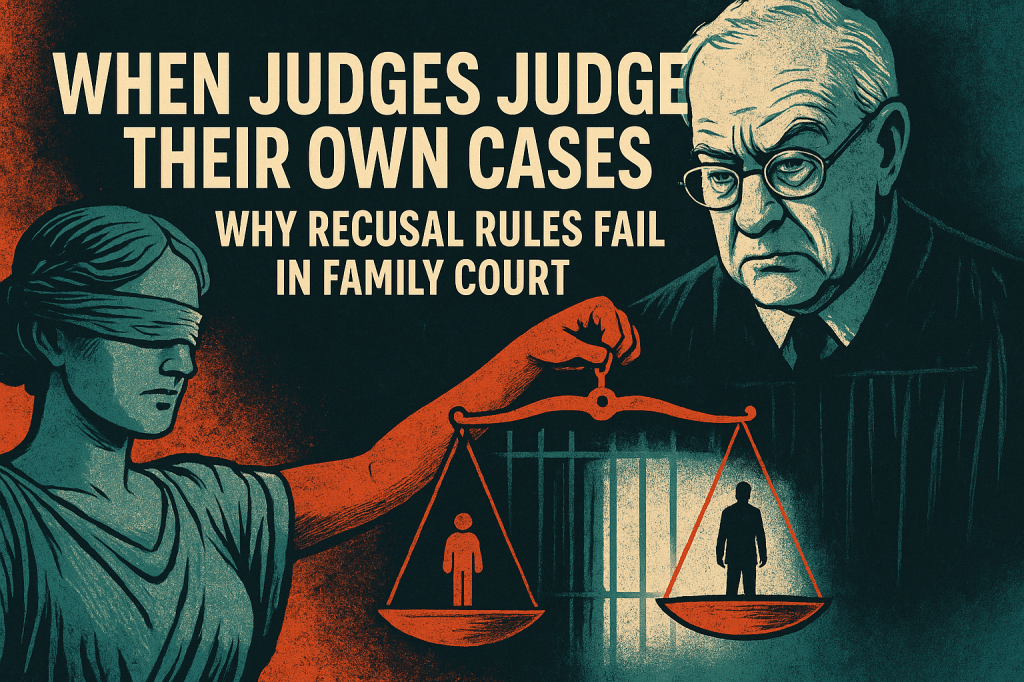
In most areas of law, the principle that no one should be a judge in their own case is sacrosanct. Yet in America’s family courts, that rule breaks down in astonishing ways. Nowhere is this more evident than in the ongoing legal saga of Marc Fishman, a father fighting to regain access to his children while navigating a legal maze that seems structurally rigged against him.
At the center of this story is Judge Michelle I. Schauer, who presided over Fishman’s custody case from 2015 to 2018. After years of contentious litigation, she issued an order mandating supervised visitation for Fishman—an order the Appellate Division upheld. Fishman claims that Schauer subsequently recused herself. He has cited multiple transcripts, emails, and statements from other judges referencing her recusal. He even submitted federal filings based on the understanding that she would no longer be involved in his case.
But at a hearing on April 28, 2025, Judge Schauer reappeared, asserting not only that she never recused herself but that she is obligated to preside under New York’s “one judge, one family” policy.
This raises a serious question: Should a judge with an extensive, contentious history with a litigant—and who has been named in related federal complaints—be allowed to return to the bench in that same case?
The answer, from a constitutional and ethical perspective, should be no. And yet, in family court, the usual standards for judicial disqualification seem suspended.
The Illusion of Impartiality
In federal court, 28 U.S.C. § 455 lays out clear grounds for disqualification, including situations where a judge’s impartiality might “reasonably be questioned.” Canon 2 of the Code of Judicial Conduct emphasizes not just the absence of bias, but the appearance of fairness.
In Fishman’s case, the appearance of fairness is undeniably compromised. He sued Judge Schauer. He sued her court attorney. He filed ADA complaints alleging misconduct. He has ongoing federal proceedings touching the very orders she issued. How can anyone reasonably believe she can be impartial now?
And yet, Judge Schauer brushed aside these concerns, stating, “Only I can decide if I recuse. I did not recuse.”
This judicial self-policing is the crux of the problem.
Why Family Court Is a Breeding Ground for Abuse of Authority
Unlike criminal or civil courts, family court is rarely subject to public oversight. There are no juries. Most proceedings are closed. And because many family court matters fall under administrative or ADR-like structures, they often evade constitutional scrutiny altogether.
Judges become entrenched. They take ownership of families. And litigants who challenge their authority risk retaliation or endless procedural dead-ends.
Fishman’s case is not unique. Across the country, self-represented parents, especially fathers and those with disabilities, report hostile treatment when they challenge judges’ rulings or file judicial complaints. Rather than triggering concern, these actions are often used to label them as “obsessive,” “abusive,” or “litigious.”
The Solution: Independent Review and Enforceable Recusal Standards
The only fix is structural. Judges should not be allowed to determine their own recusal in cases where there is an active or recent federal complaint involving the same parties or overlapping issues.
There must be a mechanism for independent review—whether through a rotating panel, administrative override, or external ethics authority. Without that, litigants like Marc Fishman will continue to face a judicial system where the judge is opponent, arbiter, and untouchable authority all at once.
If family courts want to maintain even a semblance of legitimacy, they must take recusal seriously. Because when a judge who has already ruled on your life returns to do it again, it is no longer a legal proceeding. It is ritual theater. And it must end.
If you believe in exposing injustice and fighting for real court reform, support our independent reporting.
Your donation helps us keep telling the stories the system wants buried.
👉 Donate Now — Help us fight for fairness, transparency, and parental rights. Every dollar counts.
 Republic Dispatch